Your Team Isn’t Slow, Your Escalation Process Is Killing Productivity
Your team is not slow. Your escalation process is broken… and it’s costing you hours every single day. If your team uses Slack and Jira, this is happening right now:
- Messages are ignored
- Context is missing
- The wrong people are involved
- Critical issues take too long to resolve
This isn’t a performance issue.
This is a workflow failure.
And it’s more expensive than you think.
The real problem: broken escalation workflows
Let’s call it out.
Most companies don’t have an escalation system.
They have a mess.
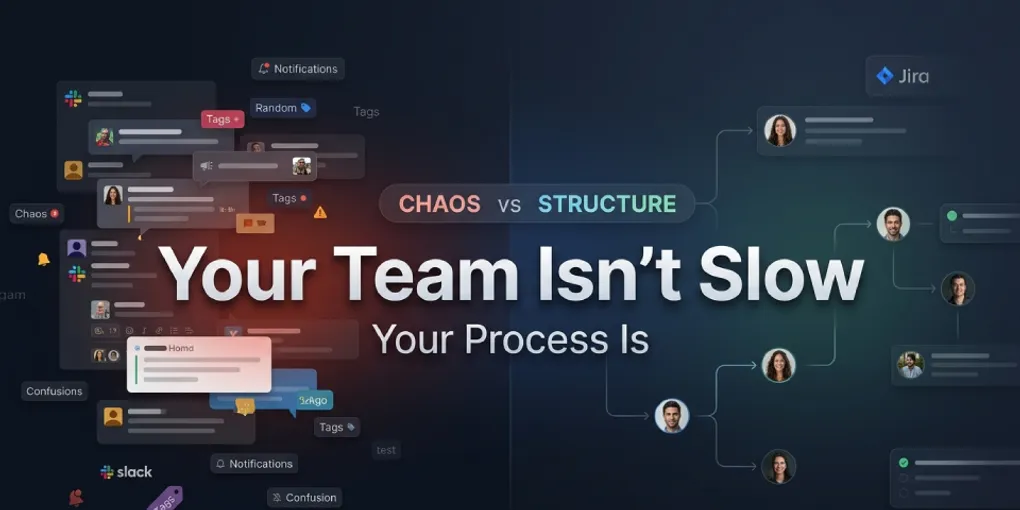
A “critical issue” shows up and:
- Someone drops a message in Slack
- A few random people get tagged
- Someone says “who owns this?”
- Jira gets updated… eventually
Meanwhile?
⏳ Time is lost
💬 Noise increases
😤 Frustration builds
This is what bad escalation looks like.
The hidden cost (productivity, team efficiency, Slack issues)
Every broken escalation creates:
- Delays in decision-making
- Duplicate conversations
- Lack of accountability
- Burnout from constant interruptions
Multiply that by every issue, every day.
This is why your team feels:
- slow
- reactive
- overwhelmed
Not because they are bad.
Because your system is failing them.
Hard truth
You don’t have a talent problem.
You have a coordination problem.
And no — hiring more people won’t fix it.
In fact, it makes it worse.
More people = more noise = slower escalation
What high-performing teams do differently
Top teams don’t “handle escalations better.”
They remove the need for manual coordination entirely.
Their escalation process is:
⚡ Instant → the right people are involved immediately
📦 Structured → context is complete from the start
🤖 Automated → no chasing, no guessing
👀 Visible → everyone knows what’s happening
No chaos. No confusion.
Just speed.
Why Slack & Jira alone are not enough
Slack is great for communication.
Jira is great for tracking.
But neither is designed for:
- real-time escalation
- automatic team coordination
- structured incident response
So teams compensate manually.
And that’s where everything breaks.
The shift: from manual to automated escalation
The smartest teams are making one shift:
👉 From people-driven escalation
👉 To system-driven escalation
That means:
- Creating dedicated channels instantly
- Pulling Jira context automatically
- Inviting the right people without thinking
- Standardizing escalation flows
This is where speed comes from.
Final thought
If your team feels slow…
It’s not because they are lazy.
It’s not because they don’t care.
It’s because your escalation process is silently killing productivity.
Fix that, and everything changes.